


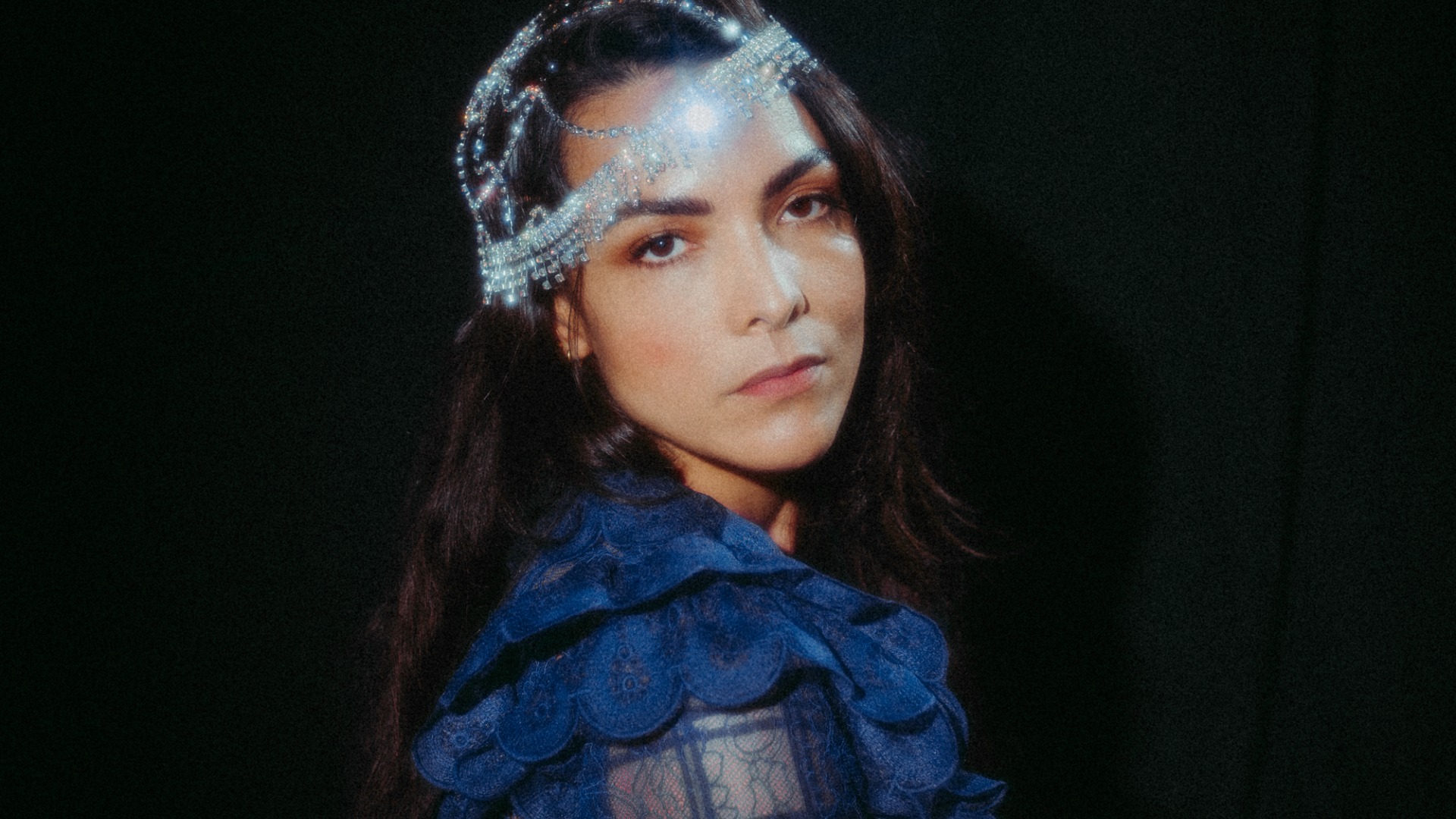
“At some point I realised: ‘Nobody’s ever gonna pull me out of this – until I do…'”
It’s a crisp, sunny Thursday morning when I sit down with Dutch singer-songwriter Caro at Soho’s Cafe Boheme during a four-day promo trip to London. It’s also the eve of her album release. ‘Returning To Innocence’ is the first body of work she’s put out under her own name and her decision to step away from the multi-million selling jazz-pop collective that took her to the top of the global charts and helped her beat Michael Jackson’s ‘Thriller’ for the longest-running No. 1 LP in her native Netherlands, she admits, was daunting.
Since their 2009 debut, she was the colourful front-woman of Caro Emerald, voicing hits like ‘A Night Like This’, ‘That Man’ and ‘Tangled Up’, with an early 20th-century aesthetic that mirrored their vintage-infused, genre-bending sound. To fans worldwide, she was Caro Emerald, but for the artist the act was a safety net. “I never really wanted to be a character, but I felt I had to because people wanted me to be. And I never questioned it because I didn’t want to look like a fool,” she admits. “Who would ever come to a show for just me, you know? So I went along with it, hoping somebody would come up to me and say, ‘You don’t need all of this’. And nobody ever did.”
Once the final Caro Emerald single was released in 2020, she began working outside of the unit and in the spring of 2022 released ‘You Don’t Even Know Me’ under the pseudonym The Jordan, a nod to the De Jordaan neighbourhood of Amsterdam in which she grew up. It wasn’t until announcing its parent album, ‘Nowhere Near The Sky’, that her identity was revealed, but this time around she’s placed herself at the heart of the music. ‘Returning To Innocence’ is lyrically and sonically driven by Caro, with its 14 tracks exploring various aspects of her being: the artist, the mother, the daughter.
“When I made the last record it felt like I just got started, but now I realise I’m a mid-career artist,” she reflects, explaining that even she struggles to get her head around the full-circle journey of finally returning to and releasing music under her own name. “I don’t know of any examples of somebody who had a collective behind their own name, and I don’t always know how to deal with it. I want to do justice to what [Caro Emerald] did together and I think choosing my own name now, just Caro, does that. It honours what we’ve done and how proud I am of that, and it allows me to bring that into my career, right now, as the artist I am today.”
It’s a return that didn’t come easy and one that plays out in the opening of ‘Returning To Innocence’. ‘Tied with one foot out the door / Tell me what I’m waiting for’ she sings on ‘Already Lost’, a track she describes as “a reckoning”. “All my doubts and fears; my fear of failure, my question marks…” she muses. “I feel scared sometimes, and sometimes I feel like a winner. I feel both.” But that sense of victory isn’t aligned with commercial success, and she’d rather stay true to herself than give in to the pressures of a male-dominated industry.

“I feel strongly that this is a very feminist album and reclaiming my own name is a very feminist move. But feminism, as it is today, is being viewed in a certain way that bugs me,” she says, pointing towards J. Howard Miller’s ‘We Can Do It!’ poster (of a woman in a red-and-white polka-dot bandana and blue work shirt flexing her bicep) that was designed to boost morale during WWII and was later adopted as a symbol of feminism. “It’s a great picture and I think it represents a lot that needs to be represented, but it also fails to show things that are very feminine and deserve to be seen. Somewhere underneath that [image] lies the idea that a successful woman is like a man: strong, decisive, and maybe even harsh. That’s not all we are – and maybe that’s exactly what we should be grateful for. I wanted the doubt and the fear to be part of that victory, ’cause that’s what brought me here.”
Across the album, she tackles various aspects of her experiences with candour; she vies for control on ‘Call The Shots’, craves attention on ‘Worship Me’, outlines her lifelong ambition on ‘Mama’ and struggles with insecurities on ‘Mirror’, citing Queen of Re-invention Madonna, Swedish melody makers ABBA and The Purple One himself, Prince, to ’90s power ballads and her parents’ love of classical music, as key influences.
All are are part of her and it’s no coincidence that ‘Returning To Innocence’ is Caro’s most raw work yet. “I spent a lot of time in the past couple of years thinking: ‘Why do I feel bad about things? Why do I feel responsible for certain things?’ All that I want, all that I crave for… it’s just human. So why are we collectively guilty, collectively embarrassed?”
Dealing with all of that head-on is ‘Goddess’, a song that was a year-and-a-half in the making. She kept a document with just one line, ‘This is my confession’, which became the opening to the track, inspired by Romanian-German producer Michael Cretu’s musical project Enigma (which, surely without coincidence, had a global 1993 hit titled ‘Return To Innocence’). “I was meditating a lot and I started to think about why certain sounds make you immediately go into that spiritual state,” she explains. “So I brought their song, ‘Sadeness’, into the session and said, ‘I want to do something like this’. And I had this one line. So they put down the beat, a bit Enigma-ish, and I started making up this lyric which [intuitively] became ‘Father, please forgive me…’ I didn’t even think of it!”
It’s one of the most instantly impactful moments on the album, supported by a spoken-word introduction from Caro’s eldest daughter that she describes as an “instruction manual for what women should be”: “I basically asked Google, ‘What does the Bible say about women?’, and these are words that I found on the Internet. It’s not a piece from the Bible and some of the words might not be exactly what’s written, but this is what I found. And I was looking at them like ‘really?’. She’s supposed to be quiet, and only open her mouth with wisdom, and she has to serve her husband and support her husband. I’m like ‘fuck’. We’re still living with this idea. It’s still inside of us.”
Her drive to tackle such subject matters and ideologies in her music is only fuelled by her daughters, aged 12 and 9, who are a driving force behind the record. In the past she’s drawn a clear distinction between her life in and out of the spotlight – combining family and work “almost felt like a devaluation of my stardom,” she admits – but for this project the lines became blurred: “If you’re talking about all sides of humanity and womanhood, then motherhood is part of it.”

She’s overcome with emotion while talking about her daughters. “There’s so many things that are unfair and I don’t want them to grow up in this world. They deserve a different world,” she says with teary eyes. “As a parent, you’re kind of powerless; you can do so much, then the rest is up to the village. The only thing I can do is give the right example and show them how I deal with all of these things that are so tough, especially on girls. That gave me the extra drive to do this.”
They are, she says, proud of her achievements in the industry and are fans of the new music – even if some of the aspirations they’ve inherited set the bar high. “My oldest daughter keeps comparing my streaming numbers to Taylor Swift‘s and I’m like, ‘That’s not really fair!’ Honestly, how am I ever gonna win?,” she laughs. But in a sense, she already has; twenty years since she was first approached to voice ‘Back It Up’, the song that would introduce Caro Emerald to the world, she returns with a defining body of work that’s among her strongest yet and makes the bold statement: this is Caro.
Having let go of the past, she’s already looking to the future. In November, she returns to London for a pair of shows at Ronnie Scott’s to round out her European tour, with talk of more new material. “I still feel like my best album is yet to come,” Caro grins. “It might not even be the next. It might be the one after that. I have so many things to explore still; it’s a great place to be in.”


